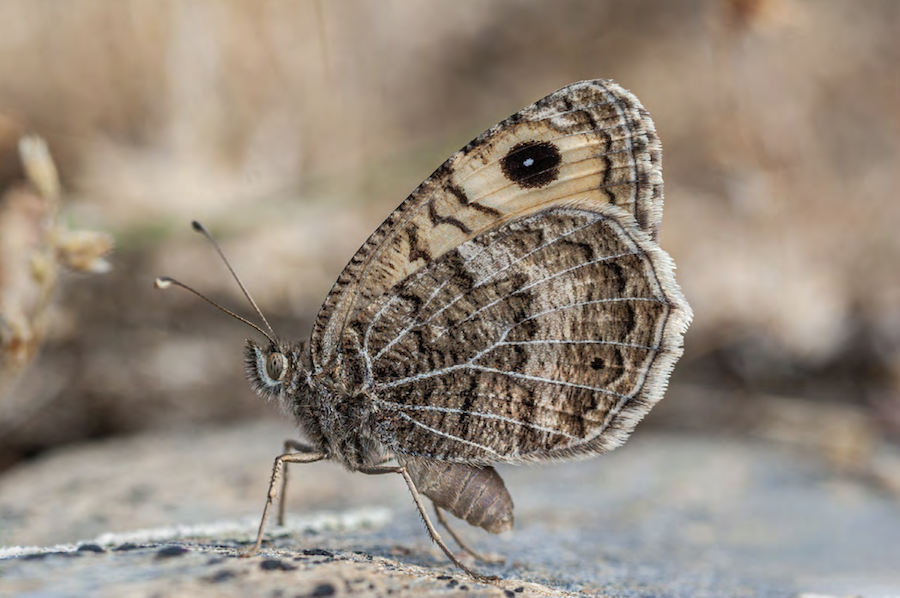
New Species Action Plan for the Critically Endangered Pseudochazara williamsi in South-east Spain
By Sam Ellis and José Miguel Barea-Azcón
Europe's butterflies are under ever increasing threat. The number of threatened species in the new European butterfly Red List has increased by 73% since the last assessment in 2010 (from 37 to 65 spp.) and 28% of all European butterflies (125 spp.) are either threatened or Near Threatened. The situation is even worse when it comes to European endemic butterflies with over 40% now threatened or close to being so.
Pseudochazara williamsi is endemic to the mountains of south-east Spain and is one of just six species listed as Critically Endangered in the new Red List. Recent surveys (mainly 2023-25) conducted by Spanish ecologists with assistance from the European Butterflies Group and Butterfly Conservation Europe, found the butterfly was extant on only four of the eleven mountains where it used to occur.
Like many species, P. williamsi is threatened by habitat loss and degradation, usually a consequence of changes in agricultural practices. In some areas, abandonment has led to scrub invasion but in others overgrazing has led to the loss of suitable habitat where both larval hostplants and nectar sources have become scarce. When habitat is lost or degraded, the butterfly also suffers the consequence of habitat fragmentation and isolation which greatly increases the chances of local extinction.
However, the decline of P. williamsi can also be attributed to climate change. The new Red List found that 52% (34 spp.) of all threatened species in Europe are now threatened by climate change. Although the warming climate has allowed some widespread species to spread north, it is having a devastating effect on certain species in both the far north and far south of Europe as well as in the high mountains. In Spain the impact of climate change on endemic butterflies has been known for some time and has already led to intensive research and the publication in 2015 of Species Action Plans for three Endangered butterflies which occur in the same mountains of south-eastern Spain as P. williamsi: Agriades zullichi, Polyommatus golgus and Polyommatus violetae.
Analyses of the historical and current distribution data, shows the median altitude at which P. williamsi occurs has increased by over 200 m in the last 25 years (from 2,103 to 2,317 m. a.s.l.). As the butterfly occurs on mountain summits, in practice this means that it now occupies a much narrower elevational range than in the past, such that the potential extent of habitat is estimated to have declined by 91.6% since the last century.
All the known information on the ecology of P. williamsi, its historical and current distribution, population and the threats to which it is subject, have been collated as part of a new Species Action Plan (11.47 MB  ) published in December 2025, only a few years after conservationists became aware of the plight of this butterfly. The plan identifies a series of actions, which if implemented, could help halt and reverse the decline. These include establishing grazing exclosures to facilitate the recovery of overgrazed vegetation; improving management of traditional irrigation channels to minimise the impact of drought; and further research on the butterfly's ecology.
Butterfly Conservation Europe welcomes this plan which demonstrates the commitment of Europe's conservation community and of the Ministry of Sustainability and Environment of Andalusia to save this butterfly from extinction.