Tree Grayling (Hipparchia statilinus)
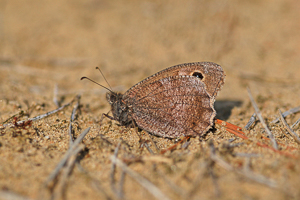
Photo © Albert Vliegenthart
| Family | Nymphalidae |
|---|
| Subfamily | Satyrinae |
|---|
| Genus | Hipparchia |
|---|
| Species | statilinus |
|---|
| Authority | (Hufnagel, 1766) |
|---|
| English Name | Tree Grayling |
|---|
| European Red List 2010 | Near Threatened (NT) |
|---|
| EU 27 Red List 2010 | Near Threatened (NT) |
|---|
| European Red List 2025 | Least Concern (LC) |
|---|
| EU 27 Red List 2025 | Least Concern (LC) |
|---|
| Habitats Directive | |
|---|
| Bern Convention | |
|---|
| CITES | |
|---|
Description
The Tree Grayling occurs in very warm, dry and nutrient-poor areas with much open ground and
sparse vegetation. The size and markings of this butterfly are very variable. While remaining on
the ground, the female deposits her eggs one by one on withered blades of grass. Grey Hair-grass
(Corynephorus canescens), Sheep’s-fescue (Festuca ovina), Brown Bent-grass (Agrostis vinealis), bromes
(Bromus spp.), Feather grass (Stipa pinnata), and other grasses are used as foodplants. The small
caterpillar passes the winter in a grass tussock and, if it does not freeze, remains active during the
winter. However, growth only begins after hibernation. As development is very slow, the caterpillar
only pupates in the summer. The flight period of the Tree Grayling, that only has one brood a year,
is therefore very late.
Distribution
Albania / Andorra / Austria / Belarus / Belgium (Regionally Extinct) / Belgium: Flanders (Regionally Extinct) / Belgium: Wallonia (Regionally Extinct) / Bosnia and Herzegovina / Bulgaria / Croatia / Czechia (Regionally Extinct) / France / France: Mainland / Germany / Greece / Greece: Mainland / Hungary / Italy / Italy: Mainland / Italy: Sicily / Lithuania / North Macedonia / Moldova / Montenegro / Netherlands / Poland / Portugal / Portugal: Mainland / Romania / European Russia / San Marino / Serbia / Serbia: Serbia / Serbia: Kosovo / Slovakia / Slovenia (Regionally Extinct) / Spain / Spain: Mainland / Spain: Balearic Islands / Switzerland / European Türkiye / Ukraine /
Larval Foodplants
| # | Order | Family | Genus | Species | Vernacular Name | Link | | 1 | Poales | Cyperaceae | Carex | halleriana | | |
| 2 | Poales | Poaceae | Achnatherum | parviflorum | | |
| 3 | Poales | Poaceae | Brachypodium | phoenicoides | | |
| 4 | Poales | Poaceae | Brachypodium | retusum | | |
| 5 | Poales | Poaceae | Bromus | erectus | | |
| 6 | Poales | Poaceae | Calamagrostis | epigejos | Wood Small-reed | |
| 7 | Poales | Poaceae | Corynephorus | canescens | Grey Hair-grass | |
| 8 | Poales | Poaceae | Dactylis | glomerata | Cock's-foot | |
| 9 | Poales | Poaceae | Festuca | ovina | Sheep's-fescue | |
| 10 | Poales | Poaceae | Festuca | rubra | Red Fescue | |
| 11 | Poales | Poaceae | Helictochloa | gervaisii | | |
| 12 | Poales | Poaceae | Koeleria | vallesiana | Somerset Hair-grass | |
| 13 | Poales | Poaceae | Molinia | caerulea | Purple Moor-grass | |
| 14 | Poales | Poaceae | Nardus | stricta | Mat-grass | |
| 15 | Poales | Poaceae | Poa | | Meadow-Grasses | |
| 16 | Poales | Poaceae | Stipa | | | |
| 17 | Poales | Poaceae | Stipa | lagascae | | |
| 18 | Poales | Poaceae | Stipa | offneri | | |
| 19 | Poales | Poaceae | Stipa | pennata | | |